
Guide
Why (and How) Should You Be Monitoring Your Customers for Risk?
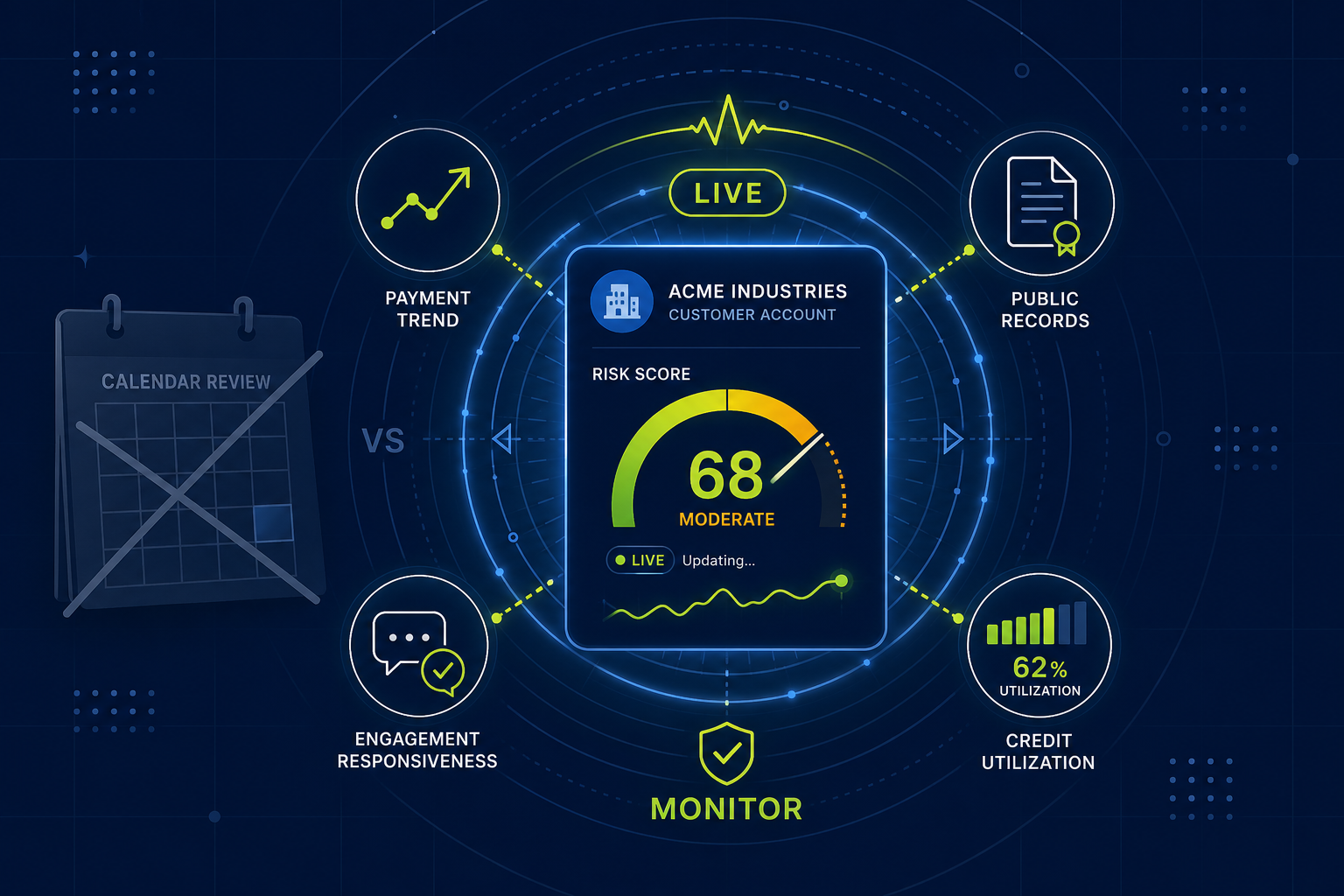
Most credit decisions get made once. A customer applies, gets approved at a limit, and then, for a lot of distributors, that's the last time anyone really looks at them until something goes wrong. A 2025 industry survey of credit professionals found that only 12% reassess credit limits when they actually receive a risk signal. The rest run on a calendar: 32% monthly, 28% quarterly, 23% annually. That means for most companies, a customer's risk can change substantially and nobody notices until the next scheduled check-in happens to catch it.
What Waiting for the Calendar Actually Costs
In early 2025, credit reporting agency Seafax downgraded Harvest Sherwood Food Distributors, then a $4 billion wholesale food distributor and one of the largest independent players in the country, from "Recommended" to "Cautionary." That downgrade was a real, external, third-party signal. It came months before Harvest Sherwood shut down its warehouses and filed for Chapter 11 bankruptcy in May 2025, following the loss of a major customer contract and mounting supplier credit issues. Any vendor watching that signal in real time had months of runway to act. Any vendor waiting for its next annual review didn't.
Why This Cuts Both Ways
Monitoring existing accounts isn't only about catching deterioration before it becomes a write-off, though that's the obvious half of the case. It's also about catching improvement fast enough to act on it. A customer whose payment behavior and financial position have quietly gotten stronger is a customer you could be extending more credit to right now, not at their next scheduled review. Missing that isn't a neutral outcome. It's a sale you didn't make, possibly to a competitor who noticed the improvement before you did and had a bigger limit ready when the customer needed it.
Both halves of this rely on the same underlying habit: treating an account's risk profile as something that moves, not something you set once and revisit on a fixed schedule regardless of what's actually happening with the customer.
What to Actually Watch
A useful monitoring practice pulls together a handful of signals, not just one:
Payment trend, not just payment status. The direction a customer's days beyond terms is moving matters more than where it sits today, the same principle covered in How Payment History Predicts Future Behavior. An account that's been drifting slower for two months looks very different from one that's been flat, even if both are technically current right now.
Public records. New UCC filings, liens, judgments, and changes in a company's standing with the Secretary of State are all information that shows up in the public record before it shows up in your aging report.
How they're engaging with you. A customer who stays responsive and communicative through a rough patch is a very different risk than one who's gone quiet, regardless of what their balance looks like on paper, a distinction covered more fully in Unwilling or Unable to Pay?.
How they're using their credit limit. A sudden spike in usage, a customer who jumps well past their normal ordering pattern, is worth a second look before it turns into a limit breach or a rejected order at the counter, the same underlying signal covered in When Should You Increase a Customer's Credit Limit?.
Credit professionals at real distributors already build their internal scoring around exactly this kind of layered view. Jessica Holt, director of credit and collections at Soligent Distribution, has described reviewing tax liens and UCC filings specifically to understand which vendors are secured ahead of her company, not relying on a credit score in isolation.
Building an Actual Cadence
None of this requires watching every account daily. It requires deciding, on purpose, how monitoring maps to risk instead of defaulting to a fixed calendar for everyone. A high-risk or high-exposure account might genuinely warrant a weekly or even continuous check. A long-tenured, low-risk account might be fine on a quarterly cycle, as long as anything unusual, a missed payment, a new lien, a sudden spike in order volume, triggers an out-of-cycle look regardless of where it sits on the schedule.
The goal isn't more work for whoever owns credit risk. It's making sure the accounts that need attention surface on their own, instead of waiting for the next date on the calendar or a problem serious enough to be impossible to miss.
If you want a simple way to start, we built a free Credit Risk Scorecard tool you can run against your existing book. Link's below.