
Guide
When Should You Increase a Customer's Credit Limit?
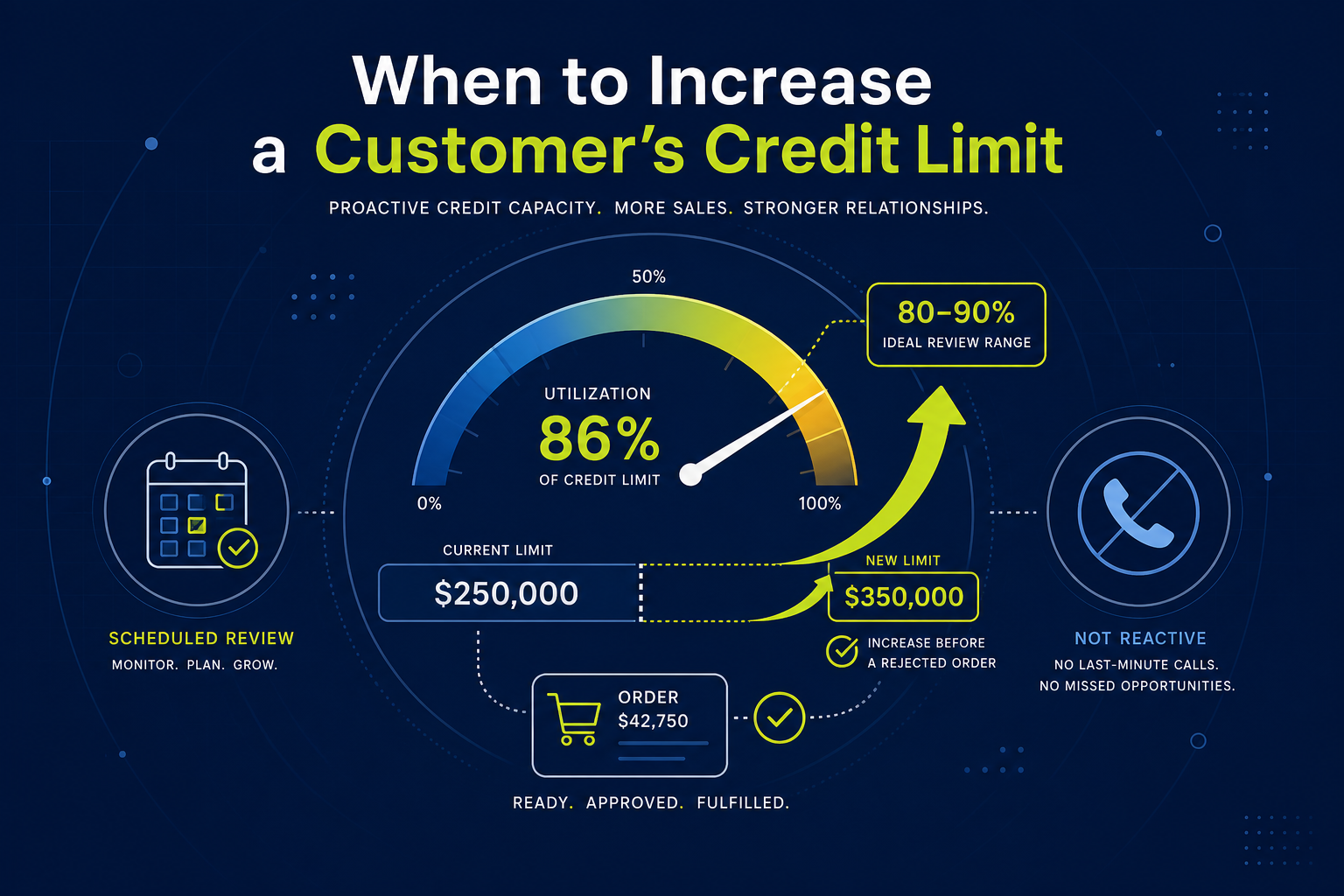
The worst time to think about raising a customer's credit limit is while a sales rep has them on the phone, or standing at the counter, waiting on an answer. By then, you're not making a credit decision. You're stalling, and every minute you take looks like friction to a customer who was ready to buy.
Most distributors end up in that moment because credit limit reviews are reactive. Nobody's watching a customer's usage against their limit until an order actually gets rejected. The fix isn't a faster response once you're in that moment. It's not being in that moment at all.
Watch Usage Before You Get the Call
A customer creeping toward their limit is visible well before they hit it, if you're tracking utilization against the limit instead of just processing orders as they land. An account that's consistently running at 80 or 90 percent of its limit, order after order, is telling you something before it ever gets rejected at the register. The signals that justify a higher limit tend to show up gradually alongside that utilization trend: consistent on-time or early payment, a steady climb in order volume that's outpacing the limit you originally set, or the kind of clean payment history that would also put an account in the relaxed end of your collections buckets.
NACM's own guidance frames this explicitly as a sales opportunity, not a housekeeping task. A marked improvement in a customer's credit position is, in NACM's words, the most desirable reason for an off-schedule limit review, precisely because it offers real sales possibilities. Waiting for the customer to ask, instead of noticing the improvement yourself, is where that possibility gets left on the table.
When an Order Already Exceeds the Limit
Sometimes the request beats your monitoring anyway. A big job comes in that needs more material than the current limit supports. When that happens, the process is the same one covered in How to Determine a Credit Limit: you're not inventing a new number, you're rerunning the same formula (tangible net worth times a risk-adjusted percentage) with updated inputs, a fresh net worth estimate, an updated risk grade, or both.
If the number the formula supports still falls short of what the order needs, that gap is exactly the situation a personal guarantee exists to bridge, as covered in Should You Be Requiring a Personal Guarantee?: not a blanket requirement, but a targeted way to say yes to a request your data alone won't cover.
Credit Limits Are a Sales Tool, Not Just a Risk Control
There's a cost to being slow here that never shows up on a bad debt report: the sale you never see, because it went to a competitor instead.
Picture an electrical distributor whose customer prefers working with them but occasionally splits business with a competitor. That customer lands a large job requiring a big material order. The competitor already has a large open limit sitting there, ready to use. This distributor doesn't, and getting one means a phone call, a wait, maybe a request for financials. The customer doesn't wait. They place the order with the competitor, not because they prefer them, but because the competitor's credit capacity happened to already be sized for the moment.
This isn't a hypothetical dynamic. Academic research on trade credit and supplier competition has found that suppliers extend more credit specifically to keep customers from switching to a rival, since credit capacity functions as a real competitive lever, not just a defensive one. A customer sitting on an unnecessarily conservative limit is, in effect, a customer a competitor has room to quietly outbid for.
The Practical Shift
Treat credit limits the way you'd treat inventory. You wouldn't wait until a customer's standing at the register to find out if you have enough stock. Review usage and payment trends on a schedule, flag accounts approaching their ceiling before they ask, and rerun the formula the moment their numbers justify it. The customers worth doing this for are the ones already proving, through their payment history, that they've earned it.