
Guide
How Payment History Predicts Future Behavior
Past behavior predicting future behavior isn't a hunch. Academic research on small and mid-sized business defaults has tested this directly, and found a firm's future default can be explained largely by historical data on its ability and willingness to pay, without needing traditional financial ratios at all. The same escalating pattern shows up across lending more broadly. Research on mortgage delinquency found that a borrower with a clean payment history has under a 0.5% chance of a new delinquency in a given year. With one prior delinquency, that climbs to roughly 4%. With three, it's over 12%. Risk compounds with a record. It doesn't reset with time.
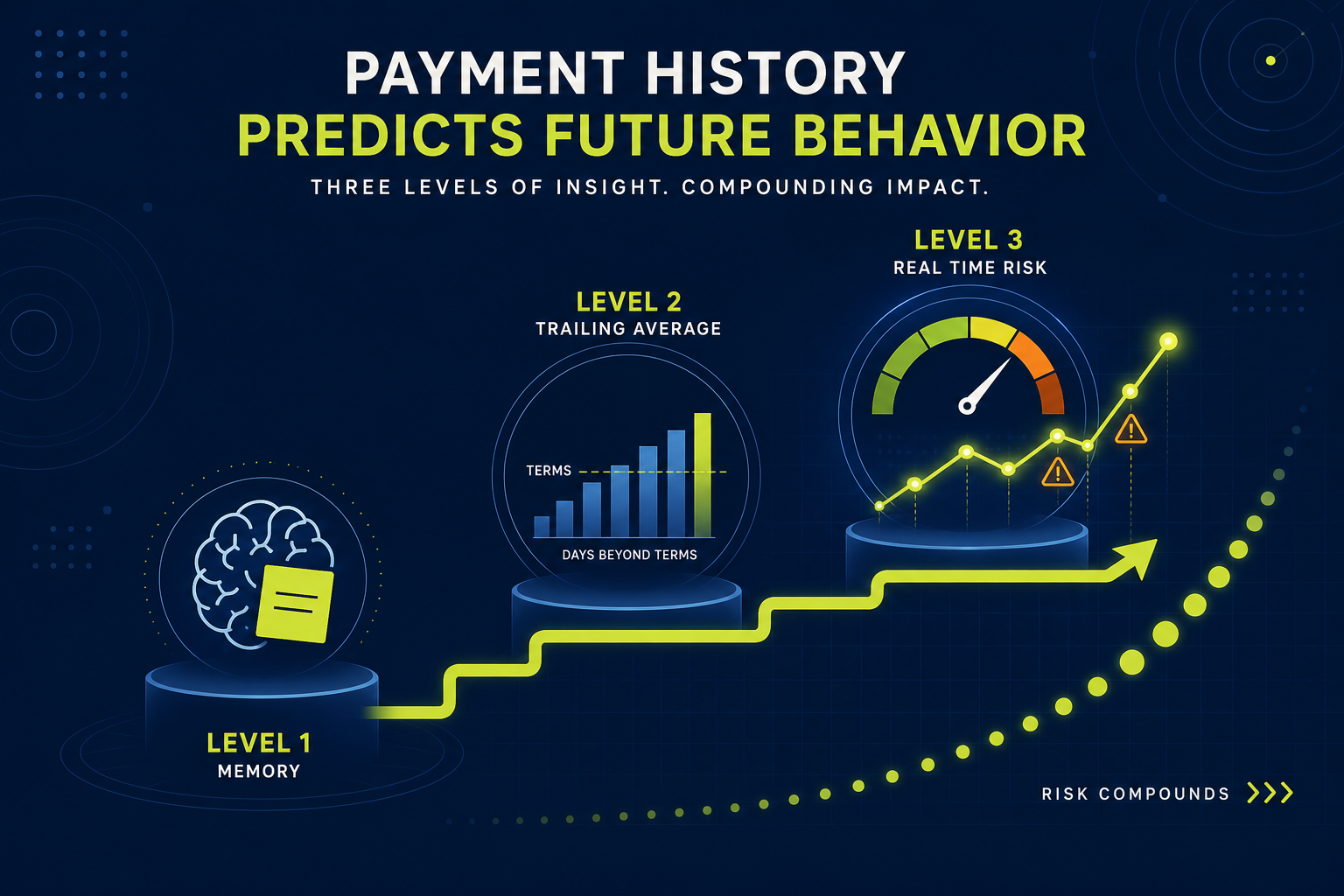
For a credit team, the real question isn't whether payment history predicts what's coming. It's how much of that signal you're actually capturing. There are roughly three levels here, and most teams are operating lower than they think.
Level 1: Remembering Who Your Problem Payers Are
This is the default for a lot of credit teams, and it isn't really a system. It's memory. The credit manager who's held the seat for five years knows which dozen accounts to worry about, because they've watched them miss before.
The problem isn't that this is wrong. It's that it's incomplete, and it doesn't survive contact with reality. Memory only holds onto accounts that are big or troublesome enough to be memorable, so the account quietly drifting from a great payer into a mediocre one gets missed until it's already a problem. It's also not transferable. When that credit manager takes vacation, changes roles, or leaves, their institutional knowledge leaves with them, and whoever's left is starting from zero on every account that isn't already flagged.
Level 2: A Weighted Average of Days Beyond Terms
The next level up replaces memory with a number. Instead of "I think they're usually late," you calculate an actual weighted average of days beyond terms across a trailing period, typically the last 12 months.
This isn't a novel idea. It's the same basic mechanic behind Dun & Bradstreet's PAYDEX score, which computes a dollar-weighted average of a business's payment experiences over a rolling 12-month window, weighting larger and more recent invoices more heavily than small or old ones. A score of 80 reflects on-time payment. A score near 50 reflects payments running roughly 30 days beyond terms. It's a real improvement over memory: objective, consistent across every account, and it doesn't forget.
But it's still a backward-looking average. Averaging smooths out exactly the thing you most need to catch early, which is the moment a normally prompt account starts drifting. An account that paid perfectly for eleven months and has been 45 days late for the last one can still show a decent 12-month average, even though the recent behavior is the signal that actually matters right now.
Level 3: A Real-Time Model That Watches for Change
The top level doesn't just measure where an account's payment behavior sits. It watches for change, and it pulls in signals a payment-timing average alone can't see.
A real-time scoring model tracks the direction of days beyond terms, not just the level, so a customer moving from 5 days late to 20 days late gets flagged well before their trailing average catches up. It layers in public record activity, new court filings, liens, judgments, and changes in a company's standing with the Secretary of State, the same distress signals that separate a customer who's unwilling to pay from one who's genuinely unable to. It factors in how an account is actually responding to your collections team, since a customer who's gone quiet is telling you something different than one who's engaging and asking for a plan. And it tracks how healthily a customer is using their credit limit, since a utilization trend creeping toward the ceiling is its own early signal, separate from whether an invoice is currently on time.
This is close to what D&B's own newer Delinquency Predictor Score actually does. Rather than relying on a single trailing average, it combines granular month-to-month payment trends with trade references, public filings, and financial data to forecast the likelihood of future delinquency, not just describe the past. Recent academic work on real-time credit scoring in supply chain finance has found scores built this way correlate strongly with a company's next-period repayment delay, which is the entire point. A good model shouldn't just describe last year. It should tell you something true about next month.
Where Most Distributors Actually Are
Most credit teams assume they're operating at Level 2 because there's a credit report with a score on it somewhere in the file. In practice, most day-to-day decisions are still made at Level 1, because nobody's actually pulling that score before picking up the phone, and the account someone's worried about is still the one they remember, not the one the data is quietly flagging.
Moving up a level isn't about working harder. It's about building a system that remembers and watches for trends on its own, so the accounts that need attention surface before someone has to notice.