
Guide
Unwilling or Unable to Pay? Why the Difference Changes Everything
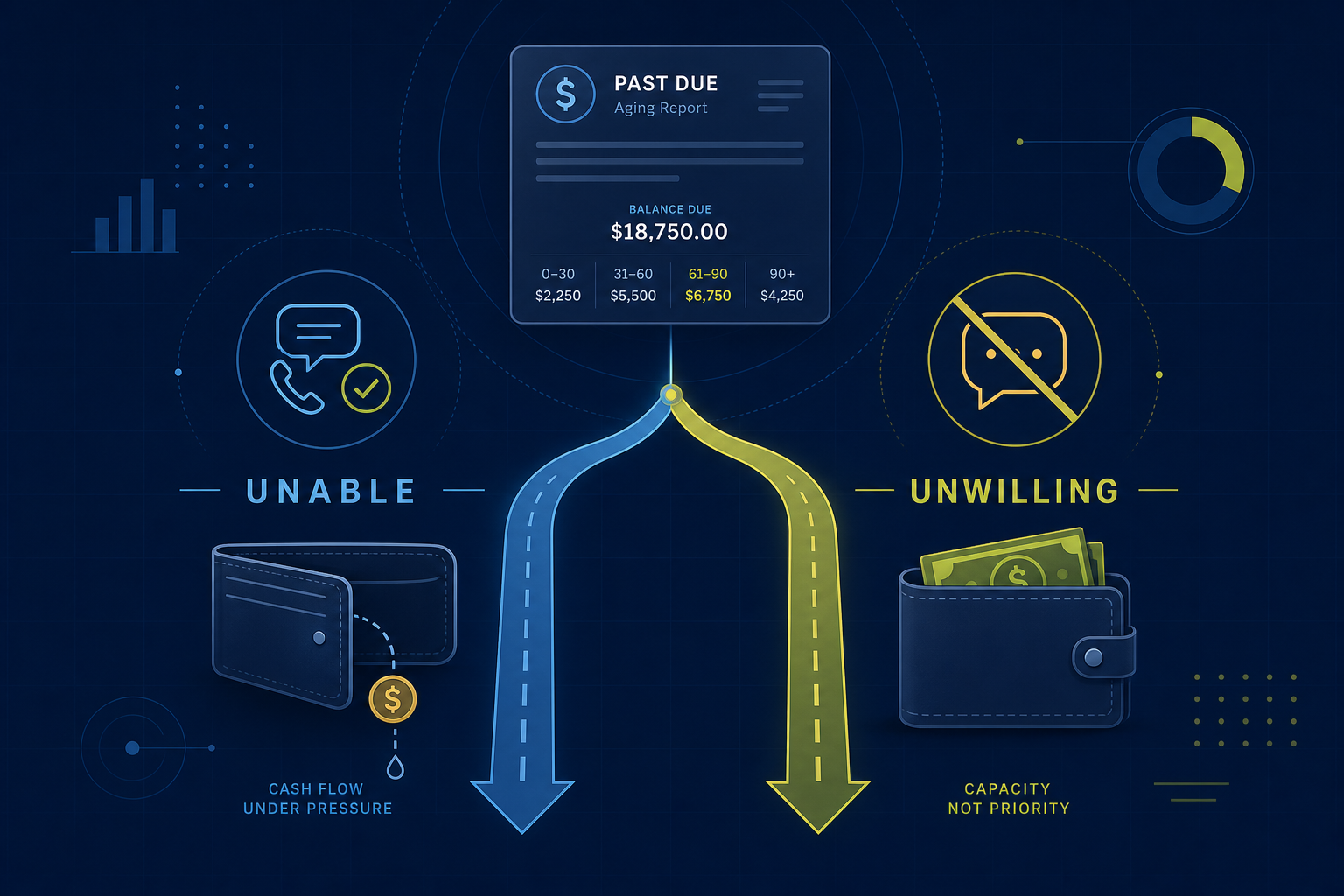
Two past-due accounts can look identical on your aging report: same balance, same days late, same silence. One customer genuinely can't pay right now. The other can, and just isn't. Treat them the same way, and you'll get the wrong outcome with both.
NACM's own foundational framework for credit risk already treats these as two separate questions. Character, one of the Five Cs of Credit, covers the moral obligation to pay debts as they come due: willingness. Capacity and capital cover the financial ability to do it. NACM's own guidance is direct on this point: credit decisions should weigh a customer's willingness to pay and its ability to pay as two separate inputs, not one blended score. Collections deserves the same discipline.
Getting this wrong costs you in both directions. Push a customer who genuinely can't pay right now down the same aggressive escalation ladder you'd use on a deadbeat, and you can accelerate them straight into insolvency, turning a recoverable receivable into a write-off and losing a customer who might have paid you in full given more time. Extend patience and soft reminders to a customer who can pay but hasn't prioritized you, and you're not being generous. You're teaching them that paying you is optional, while they stay current with whichever vendor pushes hardest.
What Their Behavior Tells You
A customer sliding toward "can't" usually keeps talking to you. They respond, explain the situation, and often make partial payments, a real signal of good faith and genuinely tight cash. A customer sliding toward "won't" tends to do the opposite: go quiet, offer vague or shifting excuses, or raise a dispute that never quite gets resolved even after you address it.
Promises are another tell worth tracking. A customer who commits to a specific pay date and hits it, even after slipping once, is showing willingness constrained by cash flow. One who repeatedly agrees to a date and misses it, especially without proactively flagging the miss, is showing you something closer to unwillingness, regardless of what they say on the call.
NACM's own commercial collections guidance points to exactly this kind of distinction. It cites a widely used framework built around comparing willingness against ability: a customer who's fully capable of paying but is withholding over something unrelated, like a delayed credit for a returned product, sits in a very different category than one showing no sign of being either willing or able, essentially unreachable. The first is a relationship to repair. The second is a signal to stop extending goodwill.
What Their Financials and Public Records Tell You
Behavior is the fast signal. Public records are the objective one. New UCC filings, mechanic's liens, or judgments against a customer are, in NACM's own words, information that "will not be visible in calling references," and they're some of the earliest indicators that a business is genuinely running out of options rather than simply deprioritizing you. A change in a customer's standing with the Secretary of State is another early flag worth watching.
There's one more signal worth checking that's easy to overlook: how you compare to other creditors. NACM's own credit reporting tools list understanding your position relative to other creditors as one of their core uses. If a customer is current with every other vendor and only slow with you, that points toward "won't," and possibly toward a dispute or relationship issue specific to your account. If they're slipping across the board, with UCC filings piling up and other trade lines going delinquent too, that's a company running out of cash, not one playing favorites.
Putting It Together
Neither signal alone is proof. A quiet customer with a clean credit file might just be understaffed. A chatty customer with new liens on record might be honestly, seriously struggling. The behavioral signals tell you what's happening in the relationship; the public record tells you what's happening in the business. Read them together, and the right response, whether that's a payment plan or a faster trip up the escalation ladder, becomes a lot less of a guess.
If you want help building this into your actual collection workflow, or automating the signal-tracking so it doesn't rely on one person's memory, we'll do a free 15-minute audit of your current collection practices against what's working for other distributors on Thor. Link's below.