
Guide
What to Do If a Bureau File Is Thin
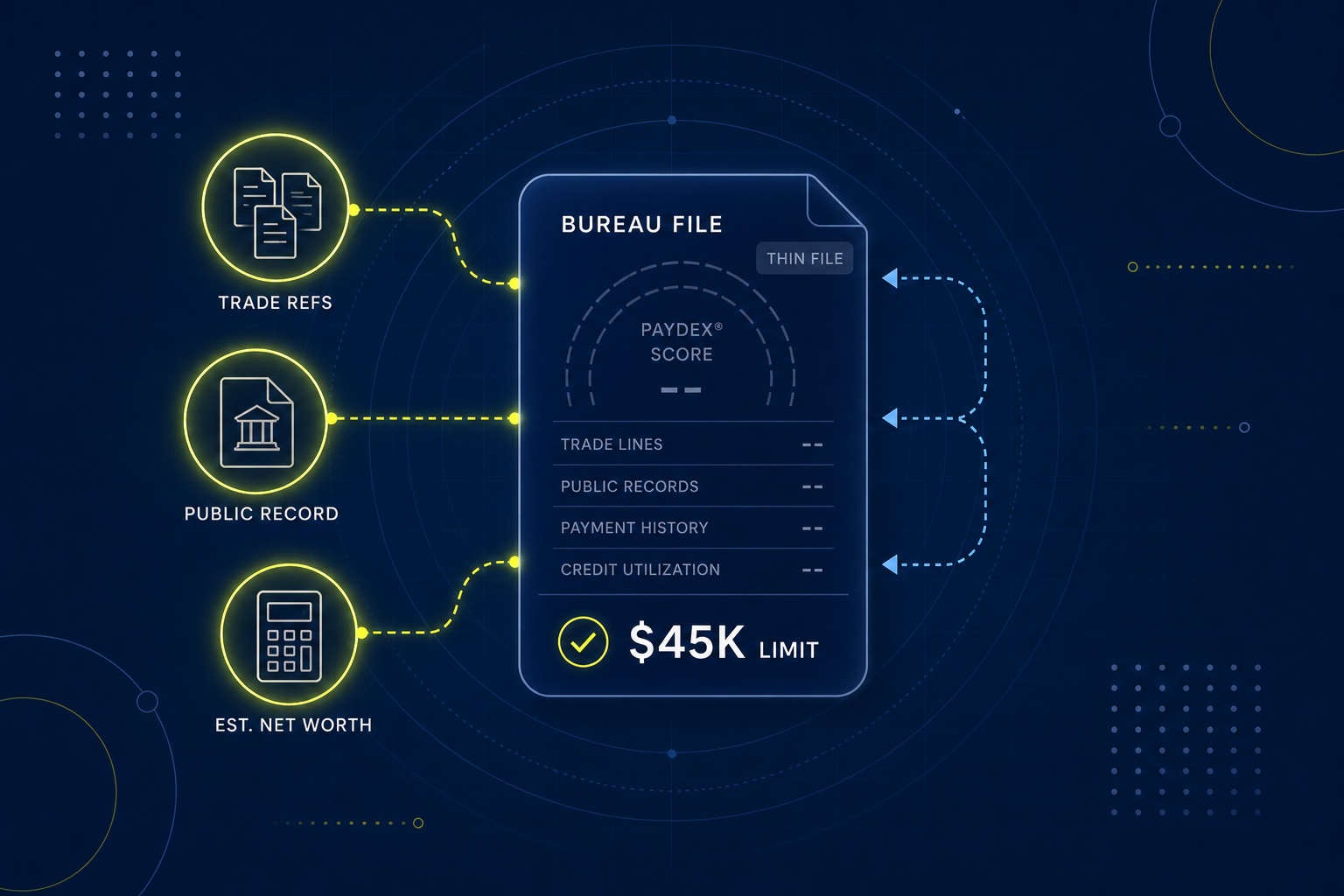
A thin or missing bureau file isn't a red flag on its own. It's the default state for a huge share of the companies applying for credit with a distributor, and there's a structural reason why. Dun & Bradstreet won't generate a PAYDEX score at all unless a business has at least three trade references reporting from at least two different suppliers, plus a D-U-N-S number. Reporting itself is voluntary on top of that. The Consumer Financial Protection Bureau found that at least 89% of banks don't furnish commercial credit data to bureaus in the first place. A young, private, or simply low-volume company can be a perfectly good payer and still show up as a blank file, because almost nobody in its financial history was reporting anything.
Treating "no bureau data" the same as "no data available at all" means turning away good customers who just haven't crossed an arbitrary reporting threshold yet, and it happens constantly in distribution specifically. New contractors, recently formed LLCs, and smaller regional operators are exactly the kind of company likely to be thin-file, and also exactly the kind of company that shows up asking for terms at a distributor. The real question isn't whether a bureau score exists. It's what you use instead.
Trade References Are Doing More Work Than People Think
The standard move for a thin-file applicant is pulling trade references, and it's still the right first step. But there's a subtler signal buried in the request itself: in Thor's own data, applicants who decline to provide the standard three references, or who stall and never follow through, tend to also score as high-risk for reasons that have nothing to do with the references themselves. The willingness to hand over three references turns out to be almost as informative as what those references actually say. A company confident in its payment history usually doesn't mind proving it. One that's cagey about it is telling you something too, the same kind of willingness signal covered in Unwilling or Unable to Pay?, just showing up earlier, before there's even a balance to collect on.
Estimate What the Bureau Can't Tell You
A missing bureau score doesn't mean a missing tangible net worth. It just means you have to build the estimate instead of buying it. How to Determine a Credit Limit covers the mechanics: employee headcount times the industry's typical revenue per employee gets you to an estimated revenue figure, and that industry's typical revenue-to-net-worth ratio converts it into an estimated tangible net worth. Run that number through the same risk-adjusted percentage you'd use for any other account, and a thin-file applicant gets a real, defensible limit instead of a guess or an automatic decline.
Lean on What's Public, Even When the Bureau Score Isn't
A business can be invisible to a payment bureau and still leave a public trail. New UCC filings, liens, judgments, and its standing with the Secretary of State are all visible independent of whether anyone's reporting trade payment history, and they're worth checking on a thin-file applicant just as much as an established one, as covered in Why (and How) Should You Be Monitoring Your Customers for Risk?. A clean public record doesn't replace payment history, but it rules out the most common reasons a thin file turns out to be hiding something worse than "just new."
Start Conservative, Then Let Real Data Take Over
The safest opening move for a thin-file account is a limit at or below whatever the formula supports, not above it. There's no payment history yet to justify stretching past what the estimate can defend, even for an applicant that looks strong on paper. If the customer needs more than that conservative estimate supports, that gap is exactly the situation a personal guarantee exists to bridge, as covered in Should You Be Requiring a Personal Guarantee?. A thin-file account is arguably the clearest case for one: there's no track record yet to lean on instead, so a guarantee is doing real work rather than just adding friction to an application that didn't need it. That's not a permanent ceiling, and it shouldn't be treated like one. Once a few months of real payment behavior exist, that account stops being thin-file by definition, and the limit should move to reflect the real data that's finally available, the same review triggers covered in the credit limit and monitoring pieces. The estimate got the relationship started. It shouldn't still be the only input a year later.
A thin bureau file is a starting condition, not a verdict. Treat it as missing information to work around, not a reason to say no.
If you want to see how Thor handles thin-file accounts specifically, including the reference and estimation logic covered here, book a demo and we'll walk through it on your own applicant pool.