
Guide
Collect What You Can: How Payment Plans Accelerate AR and Strengthen Customer Relationships
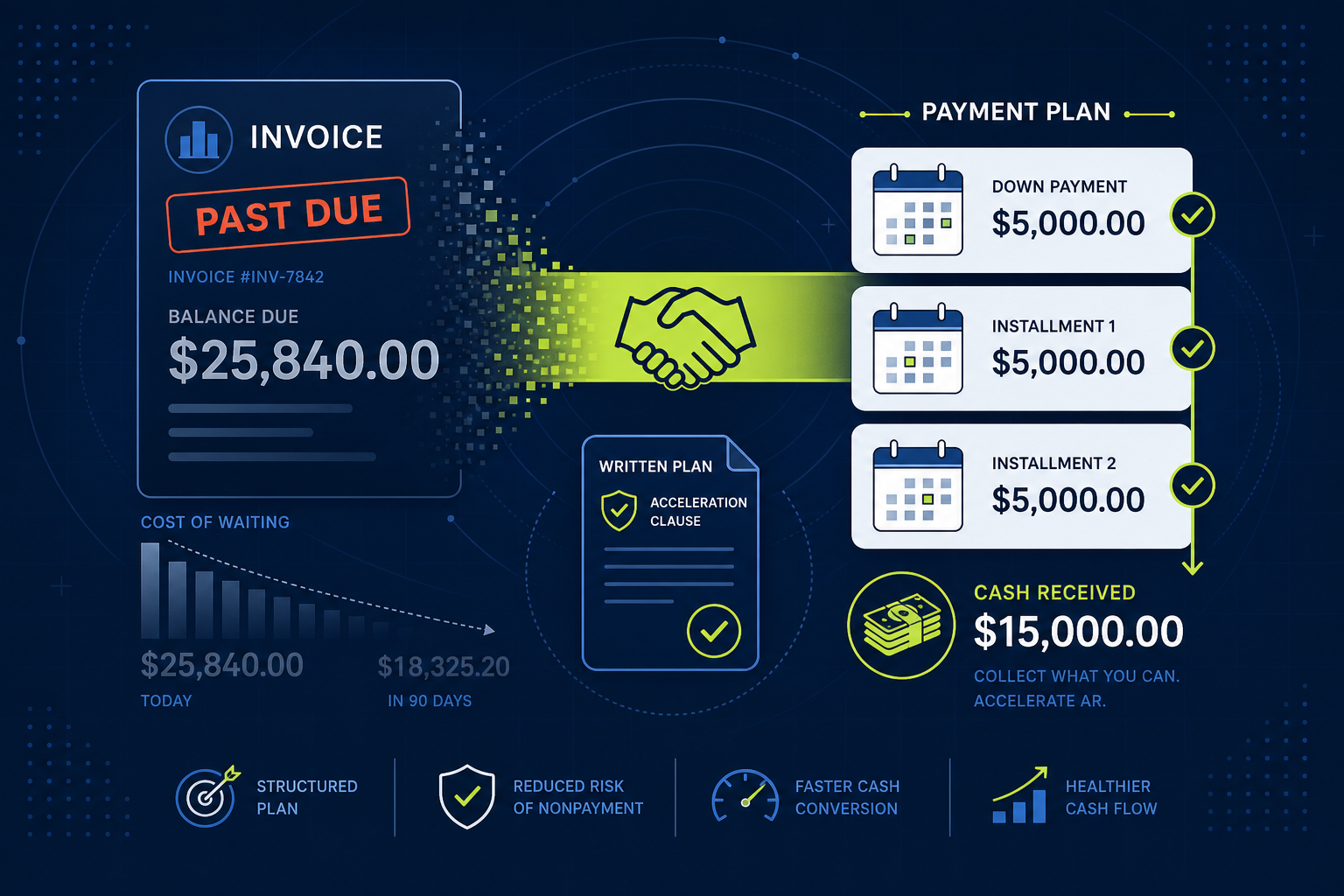
Chasing a full balance from an account that can't pay it right now isn't collections. It's a bet, and the odds get worse the longer you hold it. A payment plan, structured well, is usually the better wager: less money today, but more of it, sooner, with a real chance of keeping the customer.
The Case for Collecting What You Can
Every day a balance sits unpaid costs you something, even before you get to the risk of never collecting it at all. A model that traces back to a 2009 Harvard Business Review analysis of receivables found that an invoice sitting 60 days past due adds roughly 9% to the cost of every dollar owed, once you account for the time value of money, financing costs, administrative overhead, and rising bad debt risk. At 120 days, that cost climbs to around 27%. A $5,000 invoice at 120 days past due isn't really a $5,000 receivable anymore. It's closer to $6,350 worth of drag on the business.
Waiting doesn't just cost more. It also gets less likely to pay off. Industry estimates on recovery rates consistently show the same pattern: balances that get resolved into a structured plan recover at meaningfully higher rates than those left to sit or handed to a third-party collector, and both beat a straight write-off, which recovers nothing at all. The older a balance gets, the smaller the odds of full recovery, which is exactly why "collect what you can now" often beats "hold out for everything later." A partial payment today, locked into a written plan, converts an uncertain, decaying asset into cash you actually have.
Read the Account Before You Offer the Plan
A payment plan isn't the right move for every past-due account, and offering one too early can cost you money you'd have otherwise collected in full. This is where the signals covered in Unwilling or Unable to Pay? do real work: a customer who's responsive, has offered a specific reason for the delay, and is showing genuine intent to pay is a good candidate for a plan. An account that's gone quiet and stopped engaging should keep climbing your escalation ladder instead, as covered in How to Design a Collection Strategy, which also flags the 30-day mark as the point where it's often worth shifting the conversation from full-balance collection to a structured arrangement for accounts acting in good faith.
Structuring a Plan That Actually Holds Up
The terms of the plan matter as much as the decision to offer one. A few patterns hold up consistently across B2B collections:
Get a real down payment. Something in the 20 to 30 percent range up front turns the plan into a genuine commitment instead of a stall tactic, and gives you real cash immediately rather than a promise.
Keep the term short. 30 to 90 days covers most B2B balances. Anything longer starts to look and behave like a loan, not a collections tool, and probably needs a security interest or senior approval to justify the extended exposure.
Favor frequent, smaller payments over infrequent, larger ones. A weekly cadence surfaces a broken plan faster than a monthly one does, so you're not waiting 30 days to discover the arrangement isn't working.
Get it in writing, with a real consequence for missing it. The agreement should spell out the schedule and include an acceleration clause, meaning the full remaining balance becomes due immediately on a missed payment. If the plan breaks, the account shouldn't reset to day one. It should pick back up wherever your escalation policy left off.
Skip the interest, most of the time. In B2B collections, interest-free plans are the norm for shorter terms, treated as a goodwill gesture rather than a financing product. If a plan needs to run long enough that your own cost of capital becomes meaningful, that's usually a sign the term is too long to begin with.
Why This Protects the Relationship Too
None of this requires treating a struggling customer like a deadbeat. NACM's own guidance on commercial collections points to exactly this balance: staying firm on the need for payment while staying flexible on how it gets paid is what separates professional B2B collections from adversarial collections. A customer who gets a real, workable plan instead of an ultimatum is a customer who's more likely to still be buying from you next year, and more likely to remember that you worked with them when things were tight.
Collecting what you can isn't a consolation prize. Done well, it's usually the fastest path to getting paid, and the best odds of keeping the account.
If you want a plug-and-play way to know exactly when to shift from "collect the full balance" to "what can you pay now," we put together a set of collection plan templates you can download below.